Monday, June 20, 2011

Blood Knot

Salam

Hari ini saya kongsikan satu lagi ikatan atau simpulan. Simpulan kali ini dinamakan Blood Knot. Ianya berguna untuk menyambung dua tali yang sama saiz. Ada kalanya tali pancing kita putus atau tali pengikat sampan kita terputus. Maka anda boleh menggunakan ikatan ini untuk menyambung kedua tali tersebut.

Berikut adalah langkah atau step yang perlu anda ikuti:

Langkah 1:
pintal dua tali seperti rajah di atas. Pastikan anda membuat bilangan pintalan yang ganjil seperti 9, 11 atau 13. Semakin banyak pintalan, semakin kuat dan kukuh ikatan yang terbentuk.

Langkah 2:

Bawa kedua-dua hujung tali ke bahagian tengah pintalan. Perhatikan Rajah BK2. Hujung tali akan dimasukkan ke lubang di bahagian tengah pintalan.

Langkah 3:
Masukkan ke dua-dua hujung tali ke lubang di tengah pintalan. Ikut anak panah dalam Rajah BK3. Proses pengetatan akan dibuat dengan menarik tali utama pada arah bertentangan.

Langkah 4:
Proses pengetatan ikatan telah dibuat dengan menarik tali utama pada arah bertentangan seperti Rajah BK4. Ikatan Blood Knot telah hampir siap.

Langkah Terakhir:
Ikatan Blood Knot telah sempurna. hujung tali yang berlebihan dipotong agar ikatan menjadi kemas. Terima kasih dan selamat mencuba.

Offshore Swivel Knot

Salam.

Kita sambung semula tutorial kita berkenaan ikatan dan simpulan yang boleh digunakan oleh pemancing dalam aktiviti memancing kita. Posting kali ini saya akan perkenalkan satu lagi jenis ikatan atau simpulan yang amat berguna untuk mengikat kekilir atau mata pancing. Ikatan ini dinamakan Offshore Swivel Knot.

Ikuti langkah-langkah berikut:

Langkah 1:
Masukkan loop tali ke lubang kekilir seperti Rajah OS1 di atas.

Langkah 2:
Lipat hujung loop ke atas garisan 2 tali di atas kekilir. Perhatikan Rajah OS2 di atas.

Langkah 3:
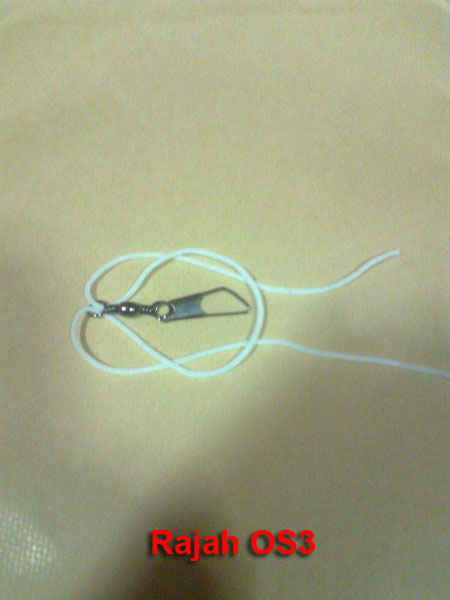
Pegang loop dan putarkan kekilir sekurang-kurangnya 5X seperti Rajah OS3, supaya simpulan menjadi lebih kuat.

Langkah 4:
Perhatikan Rajah OS4 di atas. Begitulah keadaan simpulan apabila kekilir diputarkan beberapa kali. Semakin banyak putaran yang anda buat, semakin kuat dan kukuh simpulan yang bakal terbentuk.

Langkah 5:
Ketatkan ikatan atau simpulan dengan menarik kekilir dan tali pada arah bertentangan seperti Rajah OS5. Anda akan lihat hasilnya terbentuklah Offshore Swivel Knot yang amat cantik, kemas dan kuat.

Langkah Terakhir:
Kelihatan Offshore Swivel Knot telah terbentuk. Potong hujung tali berlebihan. Pastikan, jangan potong hujung tali berlebihan terlalu pendek dari knot yang terbentuk.

Terima kasih. Bertambah lagi ilmu anda bagaimana untuk mengikat kekilir atau mata pancing. Untuk memastikan ikatan dan simpulan yang telah anda pelajari tidak lupa, selalulah menggunakan ikatan ini.

Saturday, June 18, 2011

Catfishing Rigs - 3 Simple Options And How And When To Use Them

Catfishing rigs are simply the way you present your bait to the fish. There are a number of ways of tying on hooks and weights to your fishing line. Typically the kind of water you are fishing dictates which rig is best under the conditions. Moving water versus still water. Shallow water versus deep water. A rocky bottom versus a muddy bottom. In this article we will examine 3 simple options and when and how they work best.
The simplest and probably most common setup involves tying a snap swivel to the end of the line. The snap swivel is opened and a weight with a ring in it is put on the snap portion. A leader is either tied directly to the snap or the leader loop is placed on the snap. The snap is closed before casting.
This is a good setup for fishing water that is not moving too swiftly or slow drift fishing on soft bottoms. It can be fished in shallow or deep water. The weight will take the rig to the bottom and keep it there. The bait will typically lie on the bottom. This is a good place for the bait as catfish are typically scavengers and will be searching the bottom for food. In swift moving water the bait could be buried in moving mud, sand or silt and not be found by the catfish.
Possibly the next most common rig is using a sliding sinker. The main line is put through an egg sinker or standard sinker then a barrel swivel is tied to the end of the line. A leader is tied to the opposite end of the barrel swivel. This setup, when a fish eats your bait, allows the main line to go through the weight offering less resistance than the prior example. Oftentimes the fish will release the bait if it feels the resistance of the weight as it swims off.
A good way to keep the bait off the bottom is by using a 3-way-rig or dropper loop setup. Using a 3-way swivel is the most common. One ring of the swivel is tied to the main line. A leader for the weight is tied to what becomes the bottom ring of the swivel. And a leader for the hook is tied onto what becomes the center ring. A dropper loop is the same idea without the need for a swivel. You can vary the distance the bait stays off the bottom by adjusting the length of the weight leader and the length of the hook leader.
Tackle while catfishing should be medium heavy to heavy. Use a longer rod, 7 to 10 feet, for longer casts from shore and power to fight the fish. A minimum of 25 pound test main line and 25 pound fluorocarbon hook leader is adequate for smaller fish. Lighter line can be used for the weight leader when using the 3-way-rig or dropper loop. This allows the weight to break off if stuck in rocks or debris with a fish on.
Weights will vary in size depending on depth and current. Hooks should be larger and heavier gauge wire due to the big tough mouths of catfish. Circle hooks have become a favorite among many fishermen because they are designed to come out of the fish's throat and penetrate the side of their jaw. Treble hooks can be used for dough balls and manufactured baits.
Catfish can get pretty big and will put up a good fight. Even the small ones. Even heavier line and hooks should be used if you know there are large fish in the area. You do not want to break off a trophy fish by using too light of line. These catfishing rigs are time-tested to work in many situations. You may have a favorite you use on the waters you fish. Try experimenting with different setups when fishing in current and when there is no moving water.
Keith Abraham is a catfishing expert. For more great information on catfishing rigs, visit http://www.CatFishinginponds.com.


Article Source: http://EzineArticles.com/6357283

Thursday, June 16, 2011

Bass Fishing in Changing Water Temperatures

Fish are just like any other animal specie. They like to move more when they are comfortable and move less when not. What I mean is, temperature plays a big role in the movement and activity of a bass. Bass in the early spring start moving from the deep waters to the shallows because the waters up top are beginning to increase in temperature in relation to the air temp rising. This time of the year increases the aggressiveness and movement of bass.
Another big aspect of early spring, with rising temps, is their appetite. With their increase in movement also makes them hungrier than they were during the winter months. This makes using top water baits in the shallows a lot of fun. Bass also in the spring (when water temps hit in the 60's) begin setting up their beds for the spawn. This is the time of year that anglers love to fish for bass. The excitement of fishing top water baits and having a hog knock it almost out of the water is one of the great thrills of bass fishing. That is what makes anglers come back for more.
When water temps begin to creep into the ladder 70-degree mark, you will see the fish begin moving into deeper water. They still come to the shallows in the early morning and late afternoon when the waters begin to cool, but will move back to deeper water during the heat of the day. With this in mind you will have to change your tactics as the day progresses. During the morning time you will be able to fish top water baits, shallow running crank baits or spinner baits, but will have to change when the water temp begins to rise. Just the other day I started fishing in water temps of 78-degrees, but had to move to deeper water and deeper diving baits when the water temp rose to 84-degrees. The lake I was fishing was only of 9 feet depth on average, but I was able to continue catching fish since I followed them to deeper water while the water temp rose.
One thing to watch out for in the late summer is a lake that has mainly shallow water in average of 10 feet or less. The reason is that the lake is not able to have any deep cool locations for bass or any fish specie to reside. As I said in the beginning, "fish like to move more when they are comfortable and move less when not". Kind of like me in the hot summer days (Ha!). Hot water (waters of 85-degrees or more) will make fish sluggish just like real cold water (during winter months). One area to look for in a lake like this is run off water from a recent rain or spring on the side of the bank. These waters are much cooler and will attract fish to its surrounding area. Fishing hot summer days are better utilized in a lake with deep areas, which take much longer to warm from the sun's rays. Deep diving crank baits, worms, jigs, and any deep diving or crawling bait are best during these hot days. In the thirty plus years of bass fishing, I still enjoy most the spring and fall times of the year.

Wednesday, June 15, 2011

Bimini Twist

Salam,

Dah tiga hari saya tak buat posting ke blog ini. Hari saya nak kongsikan satu lagi jenis ikatan atau simpulan yang amat berguna bagi kita sebagai pemancing. Simpulan atau ikatan hari ini dinamakan Bimini Twist.  Sebenarnya memang dah banyak laman blog atau web yang menunjukkan bagaimana untuk membuat Bimini Twist ini. Tapi saya tetap akan kongsikan dengan pengunjung blog kemahiran bagaimana nak buat Bimini Twist ini.

Sebelum saya tunjukkan langkah-langkahnya, untuk pengetahuan pengunjung yang dihormati, Bimini Twist ini selalu digunakan untuk mengikat tali ke pokok atau ke tiang khemah atau rumah rakit. Ikatan ini amat kuat dan tidak mudah terlucut.

Berikut adalah langkah dan picnya sekali:

Langkah 1:
Ikatkan tali ke batang pokok. Buat twist seperti rajah BM1.

Langkah 2:
Lilitkan hujung tali sekali lagi pada twist yang anda telah buat pada Langkah 1. Perhatikan Rajah BM2. Pegang hujung tali.

Langkah 3:

Buat simpulan pada loop utama. Perhatikan Rajah BM3 di atas.

Langkah 4:
Ketatkan simpulan yang dibuat dengan menarik hujung tali. Lihat Rajah BM4

Langkah 5:
Buat 3 atau 4 lilitan pada loop utama. Masukkan hujung tali pada loop kecil yang terbentuk dan tarik untuk mengetatkan simpulan. Perhatikan Rajah BM5

Langkah Terakhir:
Buat pengetatan simpulan dengan menarik hujung tali seperti anak panah dalam Rajah BM6. Ikatan anda telah sempurna. Anda boleh gunakan Bimini Twist ini untuk mengikat tali ke batang pokok dan sebagainya. Selamat mencuba.

Sunday, June 12, 2011

Improved Clinch

Salam pengunjung blog yang dikasihi.

Hari ini saya kongsikan satu lagi jenis ikatan untuk mengikat mata pancing atau kekilir yang dinamakan Improved Clinch. Ikantan ini sebenarnya satu lagi pilihan dari banyak jenis ikatan atau simpulan. Jika kita ada pilihan, kita boleh cuba setiap pilihan, yang mana satukah pilihan terbaik. (Sebenarnya semua ikatan yang saya kongsika adalah terbaik dan digunakan oleh semua pemancing dari seluruh dunia.

Baiklah. Ikuti langkah-lang berikut:

Langkah 1:

Masukkan hujung tali ke lubang mata pancing atau kekilir anda.  Buat lima lilitan seperti yang ditunjukkan oleh Rajah IC1.

Langkah 2:

Masukkan hujung tali ke loop kecil yang terbentuk. Secara tidak lansung, anda telah membina loop besar seperti yang ditunjukkan oleh Rajah IC2.

Langkah 3:

Masukkan hujung tali ke loop besar seperti yang ditunjukkan oleh Rajah IC3. Tarik hujung tali dan tali utama untuk mengetatkan ikatan atau simpulan.

Langkah Terakhir:

Setelah anda membuat pengetatan, simpulan Improved Clinch telah siap. Langkah terakhir anda hanyalah potong hujung tali berlebihan untuk simpulan kelihatan lebih kemas. Tapi ingat.. Jangan potong hujung tali terlalu pendek dengan simpulan yang telah terbentuk. Biarkan kira-kira 1cm panjang.

Tahniah. Anda telah berjaya.

Catfishing Bait - Should You Use Attractants?

Freshwater fishing is a major pastime in the United States and around the world. Many recreational anglers prefer to target a single species of fish. Bass, trout, panfish and catfish are favorites. While each of these types of fish has their preferred bait there are crossovers. Each species will eat worms for example. The question remains should you use homemade or commercially available attractants on catfishing bait since catfish are less picky about their diet?
Attractants have been around for many years. Some anglers swear about them and other anglers swear at them. Most attractants have an unusual smell. Get some on your clothes and your vehicle may need deodorized from the drive home. Your fishing buddies may want to strap you to the top of the vehicle on the way home. And you may have all the animals in your neighborhood become your new best friend until you change clothes.
Another issue with these products is that some of the liquid forms will stain. Stain your clothes, your favorite fishing hat, the carpet in your boat. Dipping your bait and casting will create a mist and it will be on everything. Some of the early products even blistered and pitted the gelcoat on fiberglass boats.
All the negative issues aside the fact is attractants do work. Sometimes even better than live bait. Companies that produce these products have spent countless amounts of time and money on research, development and testing. Marine biologists and anglers, professional and recreational, have been furnishing input on how the products performed or did not perform for years. "New and Improved" usually is even if the only change is that is sticks to the bait better.
One point that many anglers don't consider is the fact that attractants not only attract fish but they also mask human smell. Fish have been on earth for hundreds of million years longer than humans and have been programmed to avoid human contact. The oils in your hands are transferred to your bait, your line and terminal tackle, hooks, weights, swivels, etc. when rigging. Using a product oftentimes will aid in reducing the small and taste of these oils.
Use a cloth soaked in the attractant to wipe down your line. At least ten feet above the hook, weight or swivel. This will also remove anything leftover in the line manufacturing process. Many spools of line will have powder placed on them to keep the line from striking to itself or to the spool. Dust or small specks of plastic will attach to the new line as it is made. Placing leaders in a container of attractant for a short time may allow it to soak into the line. Placing your baits in the same or different containers will allow it to soak in to the baits and not all fly off during casting or as soon as it hits the water.
Making your own attractants can often outfish the commercial products on your home lakes. Once you come up with a good one you could catch loads of fish and maybe even sell some to your buddies or the local tackle stores.
A simple recipe is to start with some fish oil or anise oil. Anise oil smells like black licorice to us but has been proven to be a great fish attractant over the years. Experiment by adding other tastes and smells that fish like. Garlic powder is one idea and is used in many commercial products. Coffee is a new idea and tends to work pretty well at times. And not just in the morning when the fish are waking up. Just dip or soak your bait in your concoction and let it fly.
One simple, effective and inexpensive attractant for catfish is good old peanut butter. Take your catfishing bait and smear the smooth type of peanut butter on it. It sticks very well to the bait and will stay on for a long time. Peanuts contain a lot of oil. The oils will dissipate in the water and create a good smell and taste. It allows the catfish to easily locate your offering while masking the human scent.
Keith Abraham is a catfishing expert. For more great information on catfishing bait, visit http://www.CatfishingInPonds.com.


Article Source: http://EzineArticles.com/6334326